Sauna and Cold Plunge for Women by Cycle Phase and Menopause
Sauna and cold plunge for women needs re-dosing by cycle phase, birth control, and menopause. Morning basal temperature sets the week's heat and cold.

Most sauna and cold plunge for women content is a male protocol with a disclaimer stapled to it. The famous prescription behind heat therapy, four to seven sessions a week for cardiovascular benefit, comes from a Finnish cohort that enrolled only men. The practice itself transfers. The dosing was calibrated on bodies whose core temperature set point never moves. Yours is a set point that shifts monthly when you cycle, flattens on hormonal contraception, and loses its protective buffer at menopause.
Stay in the loop.
Get the latest posts and exclusive content delivered to your inbox.
Join 45 readers. No spam. Unsubscribe in one click, anytime.
The fix is a single measurable input rather than a separate women's practice: morning basal body temperature, a number many women already take for fertility tracking. Read it weekly and it tells you whether this week's heat round is a stimulus you adapt to or a stressor you merely survive. Below, that reading becomes concrete rounds, temperatures, and timing for five hormonal profiles.
The evidence gap behind unisex thermal protocols
The most-cited sauna study in the field followed 2,315 middle-aged Finnish men for roughly two decades. Men bathing four to seven times a week showed about half the fatal cardiovascular disease risk of once-a-week bathers the Finnish cohort study. Later follow-up work from the same cohort has linked frequent bathing to lower dementia incidence. Every subject was male.
When a coach or article prescribes 15 to 20 minutes at 80 to 90 °C across three rounds, those numbers trace to men or to small mixed samples. Even the cautionary literature skews male: the best-known trial showing that cold water right after lifting can blunt strength and size gains recruited young men. Female physiology differs in ways that move real numbers: sweat rates run lower on average at high heat loads, sweating switches on at a higher core temperature, cycle hormones shift the thresholds for heat dumping, and body composition changes the thermal ballast of any given round.
None of this argues for quitting. It argues for treating published doses as starting points and calibrating them against a signal from your own body.
The hormone variable that moves your set point
In the luteal phase, progesterone acts on the hypothalamic thermostat and raises resting core temperature by roughly 0.3 to 0.5 °C (0.5 to 0.9 °F). Controlled lab work shows the thresholds for sweating and skin blood flow shift upward in parallel lab thermoregulation research. The same sauna room therefore imposes a proportionally larger heat load before your cooling systems fully engage. That is the mechanism behind luteal phase heat intolerance, which is a thermostat set higher rather than a discipline problem.
Estrogen-dominant follicular weeks generally run the other way: set point slightly lower, heat dumping a little easier, and for many women the best heat tolerance of the month. That makes basal body temperature your heat tolerance anchor, and reading it takes four steps:
- Measure immediately on waking, before sitting up, after at least three hours of sleep, with the same thermometer.
- Build a follicular baseline across days 2 to 10 of one full cycle. Absolute values vary between women; your own baseline is the number that matters.
- Each week, compare the rolling three-day average to that baseline.
- A rise of 0.3 °C or more means run luteal dosing this week, whatever the calendar app says.
Single mornings can be skewed by poor sleep, alcohol, illness, or travel, which is why the rolling average does the deciding. If basal temperature stays high all cycle or climbs for weeks, treat it as a symptom flag (sleep, stress, thyroid, iron) rather than a dosing input.
Dosing sauna and cold plunge for women across the cycle
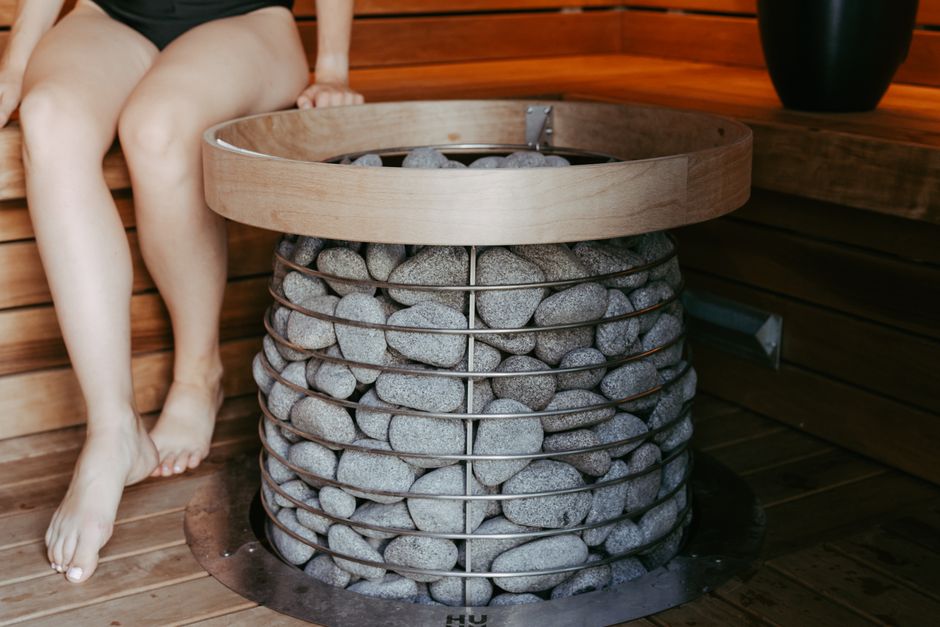
One asymmetry organizes this section: heat re-doses with your set point, cold barely does. Progesterone moves the thermostat that governs heat dumping, so sauna temperature per menstrual cycle phase swings about 10 °C across the month, while plunge numbers move a couple of degrees and a dip count at most, because phase effects on cold sensation and tolerance are small and inconsistent. The grid assumes a standard dry sauna:
| Phase | Sauna dose | Plunge dose | Timing |
|---|---|---|---|
| Follicular (day 1 to ~13) | Full male-calibrated dose, 80 to 90 °C, 3 to 4 rounds of 10 to 15 min. With the set point at its estrogen-dominant low, this is the week the default actually fits, and the baseline the luteal 10 °C cut is measured from | 8 to 12 °C, 2 to 3 min, up to two dips | Flexible |
| Ovulatory (~2 days) | Full dose, strongest week to extend a round. For many women the set-point low bottoms out here and heat dumping runs easiest | 8 to 12 °C, standard | Flexible, but keep heat a few hours from heavy lifting |
| Luteal (~day 15 to 28) | 70 to 80 °C, 2 to 3 rounds of 8 to 10 min, cooldowns as long as rounds | 10 to 14 °C, 60 to 120 s, single dip | Finish heat 2 to 3 h before bed |
Four calibration notes that decide whether this table works for you:
- Luteal logic. With your set point already elevated, dropping the dial roughly 10 °C and trimming round length keeps the session in "worked, not wrung out" territory. Start fluids and electrolytes before the first round, because sweating begins later and runs lower.
- Evening heat. Nighttime cooling is already harder in luteal and many women sleep worse those weeks. Moving heat sessions earlier in the day stops the sauna from stacking onto that load.
- Steam caution. Humid air blocks evaporation, so a 65 °C steam room can load you like a far hotter dry sauna. Treat the dial with suspicion.
- Cold by feel. A cold plunge during luteal phase often feels subjectively harder, but the small literature on phase differences in thermal sensation and cold pain tolerance is inconsistent thermal sensation research. Dose cold by response: cap luteal dips at one, and let feel arbitrate.
During bleeding days, temperature falls back toward baseline and heat can ease cramps for many women. If flow is heavy and tolerance is poor, keep luteal dosing until the basal reading confirms the drop.
Hormonal contraception flattens the signal
Monophasic pills hold synthetic hormone levels flat, and thermoregulation research on monophasic users shows the mid-cycle core temperature rise is largely absent monophasic pill research. No rise to read, so phase-based re-dosing has nothing to grab. If you sauna while on birth control and track basal temperature, expect a flat line. That is the pill working, not a broken thermometer.
Anchor to the training calendar instead, with symptom response as the feedback loop:
- Run one fixed weekly template year-round: contrast after hard sessions, sauna on easy days.
- Rate every session from drained (1) to energized (10). Two drained ratings in a row means lower temperature next week before cutting a session.
- Progestin-only methods and hormonal IUDs vary; if your thermometer still cycles, dose by the thermometer.
The operating rule is simple: track the thermometer, not the pack.
Re-dosing for perimenopause and menopause

Hot flash researchers describe a narrowed interthreshold zone, the band of core temperature within which you feel neither hot nor cold, which can shrink to a fraction of its cycling width in symptomatic menopause. Heat loads a 32-year-old absorbs without noticing can tip you straight into a flash.
Graded heat entry
- Start at 60 to 70 °C in rounds of 5 to 8 minutes, on a low bench. Heat stratifies vertically, so bench height is a temperature dial you control.
- Exit at the first flash aura. A flash inside the round means the next session is shorter, not that you quit the practice.
- Choose dry over steam, and step into moving air or a cool shower immediately after. Standing in warm, still air after the sauna is where flashes ambush you.
Cold plunge with hot flashes
Evidence grade up front: this is anecdote-heavy but low-risk territory, so cold water is a tool to try, not a promise. Plunging can cut a flash short for many women, and the immediate relief plausibly runs through the same narrowed interthreshold zone above. A flash is a heat-dumping cascade set off by a small core temperature rise inside that shrunken band, and a rapid chill to the skin can shut the cascade down mid-flight. For longer-term cold exposure in menopause, progress slowly: cool showers first, then 13 to 15 °C dips of 60 to 90 seconds, working down over weeks.
The metabolic caveat
Women tend to carry more metabolically active brown adipose tissue than men, and its activity appears to track estrogen; recent research coverage ties the postmenopausal decline in brown fat metabolism to estrogen loss rather than aging itself brown fat and estrogen. The metabolic payoff of cold is genuinely uncertain here: at least one controlled study has reported that the same cold protocol improved insulin sensitivity in men while reducing it in women. Dose cold water immersion for soreness, mood, sleep, and flash control, and decline to bank the insulin story until women-specific data lands.
Since basal temperature no longer cycles after menopause, your weekly anchor becomes flash count and sleep quality. On a bad week, heat goes down a notch, not out.
Edge cases that override everything else
Pregnancy
Obstetric guidance generally treats a maternal core temperature above 39 °C (about 102 °F) in early pregnancy as the line to avoid, given neural tube development in the first weeks. The cultural counterpoint is real: Finnish women have sauned through pregnancy for generations, and Finnish Sauna Society guidance treats moderate bathing in an uncomplicated pregnancy as acceptable for habitual bathers. Reconcile the two by keeping first-trimester heat short, mild, and far from overheating, and treating cold immersion as the piece to drop, since vasoconstriction buys little and clinicians most often advise against it. Cool showers deliver most of the contrast with less shock.
Raynaud's phenomenon
Primary Raynaud's is substantially more common in women than men Raynaud's prevalence data. In a plunge, the white-blue-red finger cascade is a warning light, not a toughness test. Keep hands out of the water, use neoprene gloves, cap dips at 60 to 90 seconds, and rewarm gradually. Fingers that blanch on every entry mean you switch to contrast showers.
Low iron and heavy periods
Iron deficiency is more common in menstruating women and blunts thermoregulation in both directions: cold intolerance is a classic sign, and heat tolerance quietly erodes alongside it. If your sauna and plunge tolerance have both slid over months, ask for ferritin and a complete blood count before rewriting your protocol. A result at the bottom of the reference range can still be too low for you, and many clinicians aim for around 30 µg/L or better in symptomatic women.
Red flags for any profile
Stop the session and cool actively if you hit dizziness, nausea, headache, sudden fatigue, goosebumps or shivering inside the sauna, sweating that stops, confusion, or chest pain. In the plunge, the stops are violent shivering, numb and clumsy hands, or breath you cannot control. Any of these ends the day. Recurring ones earn a medical visit before the next round.
Five worked dosing examples
These snapshots show what re-dosing sauna and cold plunge for women looks like week to week. All numbers are starting points; session ratings and basal trends do the fine-tuning.
Naturally cycling, luteal week. Basal averaging 36.9 °C against a 36.4 °C follicular baseline. Sauna at 75 °C, three rounds of 8 minutes with equal cooldowns, finished by 6 pm, electrolytes before and after. Plunge at 12 °C for 90 seconds, once. Running her follicular 85 °C script this week is exactly what produces the "sauna hangover" she keeps blaming herself for.
Monophasic pill user. Basal flat within 0.1 °C all month, so no phase logic. Monday hard lift plus contrast (12 °C, 2 min). Wednesday sauna at 85 °C, three rounds of 12 minutes. Saturday easy run, sauna, then 10 °C for 2 minutes. Adjustments come only from drain ratings.
Perimenopausal with daily hot flashes. Six flashes a day, fragmented sleep. Sauna at 65 °C, two rounds of 7 minutes, low bench, door cracked if needed, cool shower immediately after. Plunge at 14 °C for 60 seconds when a flash hits midday. Over several weeks, change one variable at a time (round length, then bench height, then temperature) while tracking flash count.
Postmenopausal, no hormone therapy. Heat at 75 °C, two rounds of 10 minutes, for mood and cardiovascular work. Cold at 10 °C for 2 minutes, twice weekly, dosed for soreness and resilience, with the insulin question left open. Weekly review covers flashes, sleep, and session ratings only.
Low ferritin with Raynaud's fingers. Ferritin of 14 µg/L, fingers that blanch in a cold office. Repletion comes first, with a recheck in about three months. Meanwhile the sauna holds at 80 °C with an eye on early fatigue, and the plunge becomes gloved 60-second dips at 12 °C or contrast showers. Tolerance that returns after repletion was never a discipline problem.
Build your phase-aware weekly template
This template is the layer that generic heat advice skips: a repeatable weekly protocol anchored to one trackable signal. Fill it in every Sunday.
Week of: ___
Profile: cycling / pill / perimenopausal / postmenopausal
Basal 3-day average vs baseline: + ___ °C
Heat dose: ___ °C, ___ rounds x ___ min, finish by ___ pm
Cold dose: ___ °C x ___ s, ___ dips, hands: in / out / gloved
Session rating (drained 1 to energized 10): ___
Flags hit: sleep under 6 h / flash uptick / white fingers / heavy flow / other
Then apply the decision rules:
| Signal this week | Adjustment next week |
|---|---|
| Basal 0.3 °C or more above baseline | Luteal dose: about 10 °C cooler, 8 to 10 min rounds, single dip |
| Two drained session ratings | Lower temperature 5 °C before cutting a session |
| Flash uptick after heat | Halve round length, drop one bench level |
| White fingers in the plunge | Gloves and a 60 s cap, or contrast showers |
| Sleep under 6 hours | Drop one round, keep the rest of the dose |
| Jittery 30 min after the plunge | Shorten by 30 s and warm up longer before the next dip |
The Finnish cohort will not be re-run on women anytime soon, and the small lab studies will not produce outcome data on their own. Until female-specific evidence arrives, your log is the study you control: one thermometer reading, one weekly re-dose, red flags respected. Same heat, same cold, and finally a dose that assumes your body.
Stay in the loop.
Get the latest posts and exclusive content delivered to your inbox.
Join 45 readers. No spam. Unsubscribe in one click, anytime.
About the author
Elena Park
Sleep and Recovery Specialist
Elena has spent a decade helping people fix their sleep and recover faster, pairing wearable and HRV data with the cold, heat, and breathwork protocols she tests on herself first. She writes recovery routines that hold up under real, busy lives.
Related Posts
Home Cold Plunge Buying Guide Built on Chiller Math
A home cold plunge buying framework: match chiller size to tub volume, master water care, estimate running cost, and plunge safely without a brand roundup.

Home Sauna Running Cost per Session vs the Gym Lounge
Home sauna running cost, cold plunge electricity, and water care priced per session, with break-even math showing when a home setup beats the gym lounge.
Which Luxury Gym Recovery Amenities Actually Work
Luxury gym recovery amenities like IV drips and saunas promise faster recovery. Discover which ones actually work and how to replicate them at home.